


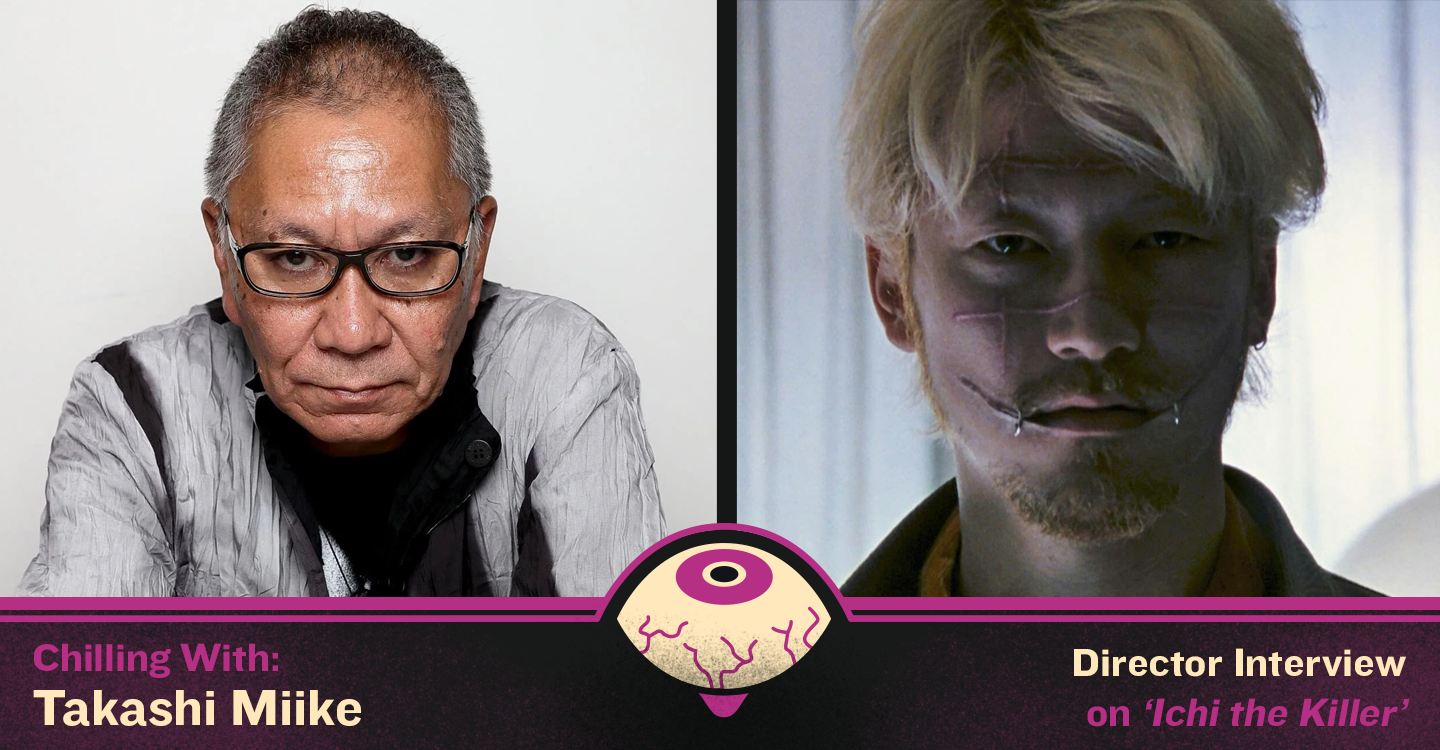
Interview by Justin Kyle, in collaboration with Rita Andreetti of Asian Movie Pulse. English translation by Nikodem Karolak.
At this year’s 30th Bucheon International Fantastic Film Festival, I had the incredible chance to attend a masterclass with legendary Japanese director Takashi Miike, who was named the guest of honor. Some films never really leave you, and for me, two of Miike’s works, Audition (with its slow dread) and Ichi the Killer (a film that famously dares you to look away), have stayed with me for years.
One of the biggest highlights of the festival was getting to see Ichi the Killer back on the big screen in a newly restored 4K version, twenty-five years after it first shocked audiences. Watching it in the dark alongside a crowd of younger viewers, many of whom weren't even born when it first came out, felt less like a simple revival and more like a torch being passed down to a new generation. The blood was just as bright as ever, proving the film hasn't aged at all. It's simply finding new eyes.
During the masterclass after the screening, Miike seemed just as struck by the moment as the audience was. As he talked about his characters, I was really surprised by the tenderness in his voice, especially given his reputation for extreme cinema. He explained that he views his characters as outcasts and misfits on the edge of society who turn to violence only because it’s the last language left to them. For Miike, that violence isn't meant to be glorified; it’s a distorted cry from people society has already written off. "I believe it is affection for people considered socially weak," he shared with the room.
That sense of affection seems to be the common thread running through his massive filmography of over a hundred movies across dozens of genres. Unlike many directors who constantly try to stamp their personal brand onto every project, Miike prefers to disappear into the material. "Many filmmakers feel an urge to engrave their identity onto a source material," he told us, "but I find that forgetting myself and respecting the work opens up a completely different landscape."
He also dropped a confession that I definitely wasn't expecting from a director I've long considered a master of horror: "I do not watch horror films at all. I genuinely cannot understand why someone would pay money to go to a cinema and be frightened. But if you ask me to film it, something different happens: I enjoy it."
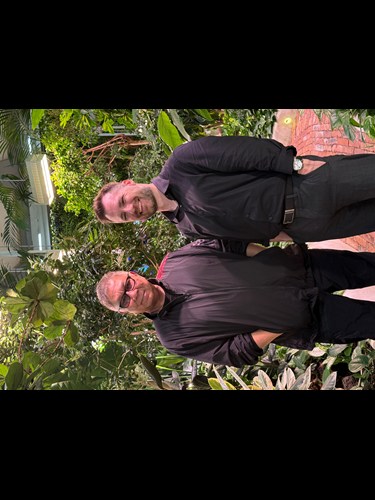
Hearing him speak on stage was an amazing experience on its own, but things got even better after the event. My colleague Rita and I actually got the chance to sit down across from him for a private conversation. Getting to chat directly with the filmmaker behind movies that have influenced me for so long was an unforgettable honor.
Here is our conversation.
Rita: Twenty-five years after its release, "Ichi the Killer" is returning in a new 4K restoration and is about to reach a whole new generation of audiences. If you were making Ichi today, would you change anything? And perhaps more importantly, do you think a film like "Ichi the Killer" could still be made with the same creative freedom today?
The most interesting thing about yesterday's screening was that there were so many young people in the room. Films normally age with their audiences, a revival screening is usually a moment of nostalgia, people reclaiming a film as their own. But after 25 years, the generation has actually changed. People who may not even have been born when this film was made were watching it for the first time. That's something completely new for me, and I felt very strongly the possibility that cinema holds.
Takashi Miike: As for whether I would change anything: with today's digital technology and CG, the degree of visual perfection would certainly increase. But when I look at my own work, I always feel that the imperfections are part of it. They belong to the time in which it was made. I can't go beyond that, and I don't think I should try.
Justin: Your upcoming projects span very different settings and budgets. Does the scale of a production affect your planning and approach?
Takashi Miike: Basically, I have always worked within relatively low budgets. In Japan, I started my career in the world of V-Cinema (direct-to-video films), which was built around a low-budget production model. "Ichi the Killer" was also made under those conditions.
When people overseas ask how many days it took to shoot or how much the film cost to produce, they are often surprised by the answer and find it impressive. However, I do not really think about budgets in terms of global comparisons — whether a film has a higher or lower budget than others.
What matters to me is how we take the budget we are given and make the most of it, using every resource carefully and efficiently without wasting anything. Sometimes that means sacrificing our own sleep in order to focus on making the film more exciting and compelling. That kind of working style was more accepted in the past. Today, it has become much more difficult to work that way, but personally, I enjoyed that period. I found it very rewarding.
If you start comparing yourself with others, there is no end to it. Having a large budget does not automatically guarantee that a film will be interesting — cinema history has proven that many times. For me, there is a unique appeal in creating films with limited resources and finding ways to bring out their full potential.
Rita: During the Masterclass you said that one day you would like to change your name and make a film anonymously, without audiences knowing it was directed by Takashi Miike. After more than a hundred films, do expectations ever become a burden?
Takashi Miike: Even watching someone in "Ichi the Killer", there are audiences and producers who think: this person could actually film the joy and sadness of an ordinary family. That encounter, being seen for something beyond what you're known for, is part of what I mean.
Horror directors almost always make horror films. I've always thought that was a little strange. Why do they keep doing that? The answer is probably that they're genuine fans of horror: it's their world, their goal. But for me, the happiness of being a director lies precisely in discovering the things you didn't know about yourself: the stories that fit you perfectly, the ones you were perhaps supposed to make.
I shoot many different genres. But when it comes to what gets exported abroad and screened at international festivals, it's always the violent and the horrifying. In reality, I've made TV dramas for girls between three and five years old. Directors who aim to become masters of a single genre have a clear goal, but I feel that goal as an obstacle. My name has become a kind of label, and that label closes off possibilities. That's why I sometimes think: I'd like to use a different name and make something that nobody would expect from me.
Justin: Looking back on more than thirty years and over a hundred films, has your career lived up to what you once imagined, or has it taken you somewhere completely different?
Takashi Miike: I entered the film industry when I was around twenty years old. As in many other countries, the usual path in Japan is to begin as an assistant director. The role is to create the best possible working environment for the director, the screenwriter, and the actors.
In doing so, I had the opportunity to observe countless actors at work and to watch a wide range of directors with very different approaches to filmmaking. Every member of the crew also brought their own pride and expertise to the set, and a large part of my job was making sure all of those individuals could work together as a single team.
At that stage, I simply regarded it as my profession. I wasn't working as an assistant director with the ambition of becoming a director myself. To me, film directors were exceptional people — individuals blessed with remarkable talent, strong personal connections, years of study, and the dedication required to master their craft. What fascinated me was not the idea of directing but the mechanics of filmmaking itself: how a film set functioned, how people collaborated, and how an entire crew came together to create something.
Then, quite unexpectedly, someone encouraged me to direct, insisting that I was capable of doing it. I was offered the chance to make a low-budget film, and I thought that, after spending so many years observing productions as an assistant director, I could probably make a decent film myself. From there, everything happened very quickly. Before I knew it, years had passed, and I found myself still making films.
At the time, I could never have imagined that I would spend my life directing films, let alone that works I had made twenty-five years earlier would still be screened at festivals and discovered by a new generation of young audiences in Korea. In that sense, my career has exceeded anything I could ever have imagined. It has taken me to places beyond even my own expectations.
Paradoxically, that has also left me feeling that I no longer have anything I need to protect. I simply devote myself completely to each new film.
Once protecting the position or reputation you've built becomes your primary objective, it's easy to start making creative decisions based on preserving that status rather than following your instincts. I no longer think that way. Even if my career were to end with my next film, I would have no regrets.
That, in turn, has given me an extraordinary sense of freedom — one that only seems to grow stronger with time.
Rita: We seem to be living in a time when war and violence have once again become part of our everyday reality. Do you think cinema has a responsibility in the way it portrays violence today?
Takashi Miike: Yes, I think so. In the end, if something appears on screen, then you have to take responsibility for it.
When you're making a film and releasing it, you don't really feel any sense of responsibility at that stage. But if the film is criticized by society or comes under public scrutiny, then accepting that responsibility is part of a director's job.
That said, I think it would be a shame if, out of fear of the consequences, a director chose not to do what they felt they should do — or what they genuinely wanted to do.
As for violence in films and violence in real life, I believe they are completely different things.
Of course, it's possible that someone might watch a director's work, feel that it awakened violent impulses within them, and then go on to commit a crime. That could happen. But in that situation, the question is: should the director be held responsible? And even if they should, is it actually possible for them to take responsibility for such an act?
Some people see films as a mirror of society, and I think that's certainly one valid way of looking at them. But I also believe that cinema belongs to the world of entertainment in a broader sense. It has the ability to take a step back from reality — to observe it from a more objective distance, even to transcend the immediate flow of time. That's what makes it fundamentally different from reality itself.
Justin: The things people most associate with your films are often either horror and violence, or on the opposite end, love and tenderness. Why do you think those two extremes are what audiences latch onto? Is there a different approach when conveying them, or something fundamentally in common?
Takashi Miike: Well, I don't really change my filmmaking approach or way of thinking depending on the genre. What really creates the differences are the characters themselves — their personalities and who they are. A story begins with questions like: What kind of person is this? What frustrations do they have? What do they want to become? That's where the narrative comes from.
And it's not just the protagonist. The people around them also matter. Their lives and motivations overlap, and that's what ultimately creates a film. If one of those characters happens to be a yakuza, then the story may naturally become violent. But a sudden traffic accident in the middle of an ordinary, peaceful family life — that, too, is an extreme form of violence.
Violence can arrive without warning. You expect a yakuza to be violent — that's part of who they are. But when an ordinary person, in a single moment of anger, ends up committing an act of violence, I think that's where you can truly express the frightening nature of human beings and of violence itself.
So I don't consciously switch styles depending on the genre or the type of story I'm telling. Instead, I let the characters guide everything. My direction changes according to each character, and I believe I approach every one of them with great care and attention.
Rita: After directing for over forty years, and proving that a filmmaker doesn't have to be defined by a single voice or genre, how do you keep your creative energy alive?
Takashi Miike: It's not a special phenomenon, honestly. When you're hungry, you eat. You live every day. Making films is how I live. It doesn't feel very different from that.
But there is a story I want to tell. Twenty-five years ago, "Ichi the Killer" was finished and selected for Midnight Madness at the Toronto Film Festival. I was travelling to Toronto via Los Angeles, promoting another film along the way. The day I left, the September 11th attacks happened in New York. The planes stopped. I was stranded in Los Angeles. I assumed the festival would shut down. Instead, the Toronto Film Festival announced: the screenings will continue. Films will not lose to terrorism. I thought: how cool. And "Ichi the Killer" screened as planned.
Everyone was in a state of fear and shock. And yet that night, the audience gathered, and the entertainment happened. For the screening, I had put airsickness bags on the seats, the kind that used to come in aeroplanes, with a note: if you feel like you're about to be sick, use the bag. Keeping the spirit of entertainment intact, even in that moment. That is the memory I carry of this film and its relationship with the world.
And now, twenty-five years later, I'm here in Bucheon watching it with young Korean audiences. There is no better job than this. As long as someone says 'you can still make something like this' I will show up and make it together with them. That feeling has not changed at all.
