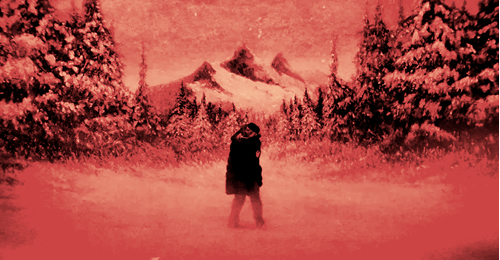



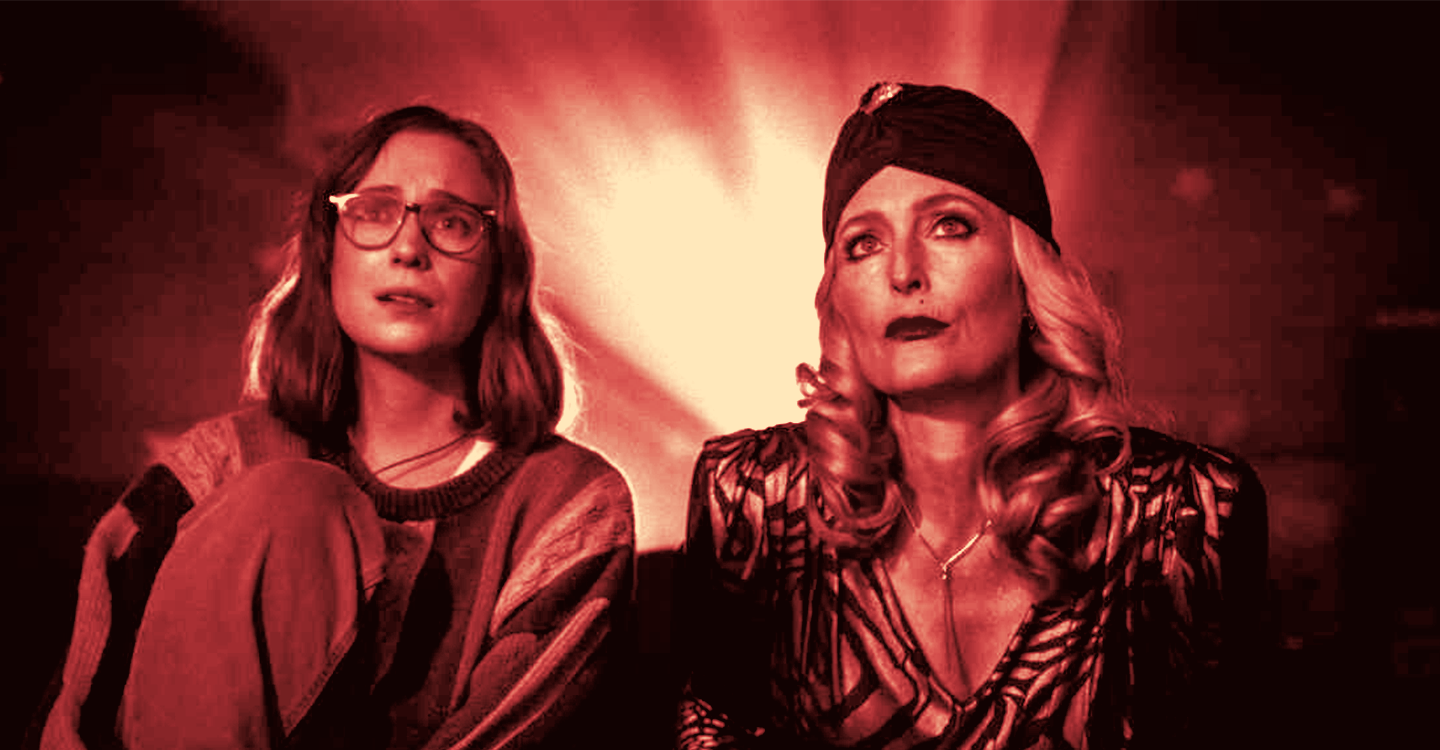
I didn’t really buy into the initial Jane Schoenbrun craze a couple of years ago with I Saw the TV Glow. As a newly out trans person, still figuring out how to feel comfortable in the world, in my relationship, and with myself, everything I heard about the movie made me afraid to watch it. I worried I would sit there thinking, “Oh shit, what have I done?” As usual, my pre-anxiety, doom-spiraling brain took over.
So, in true form, I watched it on a 14-hour flight to Korea. No better way to sit with something than to be stuck with it in a giant metal tube 35,000 feet in the air.
That fear has been a central theme throughout my transition. I was trapped in my own head, first around the idea of being disconnected from my body, then around telling my partner a couple of months before we got married, telling my family and friends two weeks before our wedding, exploring gender-affirming care, and taking a huge risk with my relationship, our dynamic, and our love life. It was a lot. And part of me knows it was okay to be in my head. Who wouldn’t be? The social, cultural, and relationship changes that came with figuring out my own identity put a cloud over that first year that I only vaguely remember.
As a kid, I was terrified by the changes happening to my body. I hid them, felt embarrassed by them, and honestly don’t remember having a single positive conversation with either of my parents about “the change.” Even now, thinking about that period of my life makes me feel dysphoric and disconnected. Transitioning forces you to be open about the parts of you you are most uncomfortable with, from all directions, all the time.
So the experience of transitioning, being forced to become open with yourself, to examine your body and your relationship to it, to confront your desires, and then to share those discoveries with the world, can feel almost impossibly vulnerable. You are not only trying to understand yourself, you are also realizing that other people will inevitably begin to see you differently, whether you want them to or not. And in today’s world, not knowing how people will react, or what that means for your safety in the world, is something I sadly think about far too often.
I truly don’t think I’d be on this earth if I hadn’t transitioned. I am so much more in tune with myself now. I don’t shudder at the thought of having a body. I feel confident in myself. But at the same time, transition is horrifying.
If It Gets Too Real…
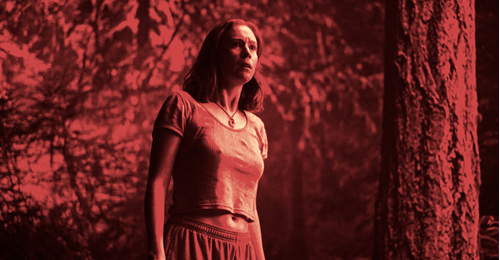
Cue Camp Miasma. I went into this movie expecting it to be trans-coded. It definitely was. Maybe not as obviously as I expected, but there were moments that really stung.
Kris, the main character, is a queer, intellectual she/they who is very much in her own head. As a kid, she becomes obsessed with the Camp Miasma movies, especially the original, where Billy has a moment that stays with her. After Billy is stabbed by Little Death, she has an almost euphoric look in her eyes. Kris can’t explain why the scene affects her so deeply; she just knows that something about it feels different. I understand that feeling. There can be a visceral recognition of something before you have the language to explain what it is. For Kris, Camp Miasma gives her a way to experience a feeling that she wants, even before she understands what that feeling actually is. For me, it was feeling “just right” in a pair of jeans or turning in the mirror and seeing a flat chest, without knowing what those feelings meant for my gender or expression. It always strikes at the oddest times, but that feeling is a brief glimpse for Kris, I think, of a thought that isn’t intellectual in nature. It is deep and primal, and something she cannot comprehend fully.
Billy represents more than sexual desire. Kris is drawn to that euphoric look in Billy’s eyes because, on some level, she wants to experience it herself, to become the person who can feel that way. The movie gives Kris an early glimpse of a self she cannot yet articulate. Like many trans people, she finds something in her world that feels unattainable in her own life, but somehow recognizable and tangible.
The irony is that Kris is incredibly intellectual. She wants to understand the world, and herself, through ideas, categories, and the “correct” way to process things. She is deeply in touch with herself intellectually, but almost completely disconnected from her body.
Billy is the opposite. She is visceral, sensory, and unashamed. She eats junk food, pursues pleasure, and trusts what her body wants. When Billy tells Kris that it is all about “flesh and fluids,” it initially sounds almost gross. But the film suggests that Billy understands something Kris doesn’t. Sometimes your body knows what it wants long before your mind can explain it.
Throughout the movie, Kris takes small steps toward that kind of bodily experience. She indulges in fried chicken and candy, fantasizes about Billy, and tries to act on those desires. But she still can’t quite access the pleasure she is searching for. Then, during sex, Billy asks her a remarkably simple question: What makes you feel good?
Kris doesn’t know.
It is such a basic, primal question, yet no one has ever really asked her, and she has never learned to ask herself. For someone who has spent her life trying to understand herself intellectually, the question forces her to confront something much harder: What does my body actually want?
I think Schoenbrun perfectly articulates this internal battle faced by people experiencing gender dysphoria and transition. Putting the pieces together, what makes me feel good, and what does my body actually want, is something most people never have to consciously consider. For them, it simply is. But through culture, experience, and finally having language to describe these feelings, trans people can begin to recognize that these questions actually have answers.
You Can Always Turn It Off.
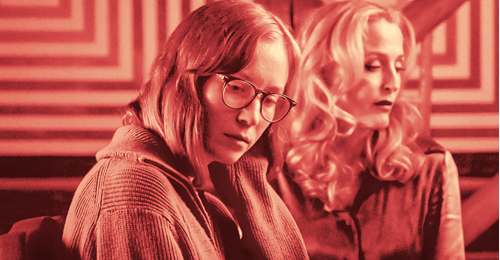
Transitioning is vulnerable. It may be the bravest thing I’ve ever done, even though, in reality, it often felt like a basic survival mechanism. Most survival mechanisms, unlike transitioning, have a concrete solution. Falling out of an airplane? Deploy a parachute. Accidentally chopping off your leg? Grab a tourniquet. Sending a vulnerable letter to 80 people on your phone telling them you are trans, you’re going by a different name, and you have no idea what will happen next? That’s on you.
The vulnerability of transition can feel almost cinematic. Dissociating in a dressing room while trying on swimsuits. Lying in bed for hours, looking down at your body and not recognizing yourself. Dysphoria can feel like watching yourself from the outside, feeling pain, sadness, and discomfort without fully understanding where it comes from or how to make it stop. Even looking back at my pre-transition life, especially childhood, it often feels unreal. There is a strange distance between those experiences and the person I am now.
That is part of what Schoenbrun captures so well: a sense of surrealism, of fictional sets that look real but somehow exist at a distance. They are familiar and even beautiful, but they don’t quite feel like your life.
Then, slowly, things start to get real. You realize you’re in your late twenties and, for the first time, find words that describe feelings you’ve carried your entire life. You put on a binder and feel comfortable in a T-shirt. Someone uses the right pronouns, maybe even by accident, and something inside you clicks. Turning offthe dysphoria starts to feel possible.
Until You Can’t.
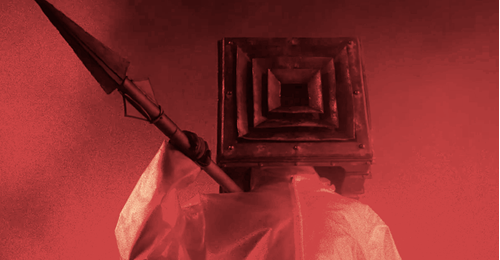
Kris moves through the film in several roles. She begins as a spectator, watching Camp Miasma and fixating on what Billy represents to her. Slowly, she becomes someone being watched, first by Billy, and eventually by Little Death. Little Death then pushes her from spectator to participant. What initially appears to be a terrifying pursuit becomes a form of liberation. He forces Kris toward herself and toward the experience she has been trying to understand for years.
Little Death literally forces Kris to act. She is chased through the woods with a spear and has no choice but to run. But as she runs for her life, she begins to transform. She strips off her clothes, down to her underwear, and starts to enjoy the chase. For the first time, she is experiencing her body rather than observing it. Little Death, in this sense, forces Kris to be her true self.
When Little Death finally stabs Kris as she experiences an orgasm with Billy, she has the same look in her eyes that she has been chasing since she first watched the original Camp Miasma . She finally understands the feeling she could never put into words. Her body finally feels like hers.
I interpreted the final scene as Billy and Kris walking together in the afterlife. It takes death for Kris to finally understand who she is and experience life in its purest form. People often describe transitioning as a kind of death, and in some ways, it can be. You lose the version of yourself who was holding onto a life that you had been conditioned to believe made sense. But letting go of that self can also mean letting go of the inhibition, shame, and distance between you and your body.
Eventually, you can’t turn it off. Once you experience what feels real, going back to pretending becomes almost impossible.
There is a strong sense of camaraderie in this film for me, and I hope there is for others, too. The film is written and directed by a trans filmmaker, it is in theaters, and it is being talked about. More importantly, it presents queer and trans self-discovery as something that can lead somewhere, not just toward survival, but toward pleasure, connection, confidence, and fulfillment. That is what resonated with me most. Camp Miasma visualizes self-discovery. It can be terrifying, but it can also be the first time life finally feels real.