



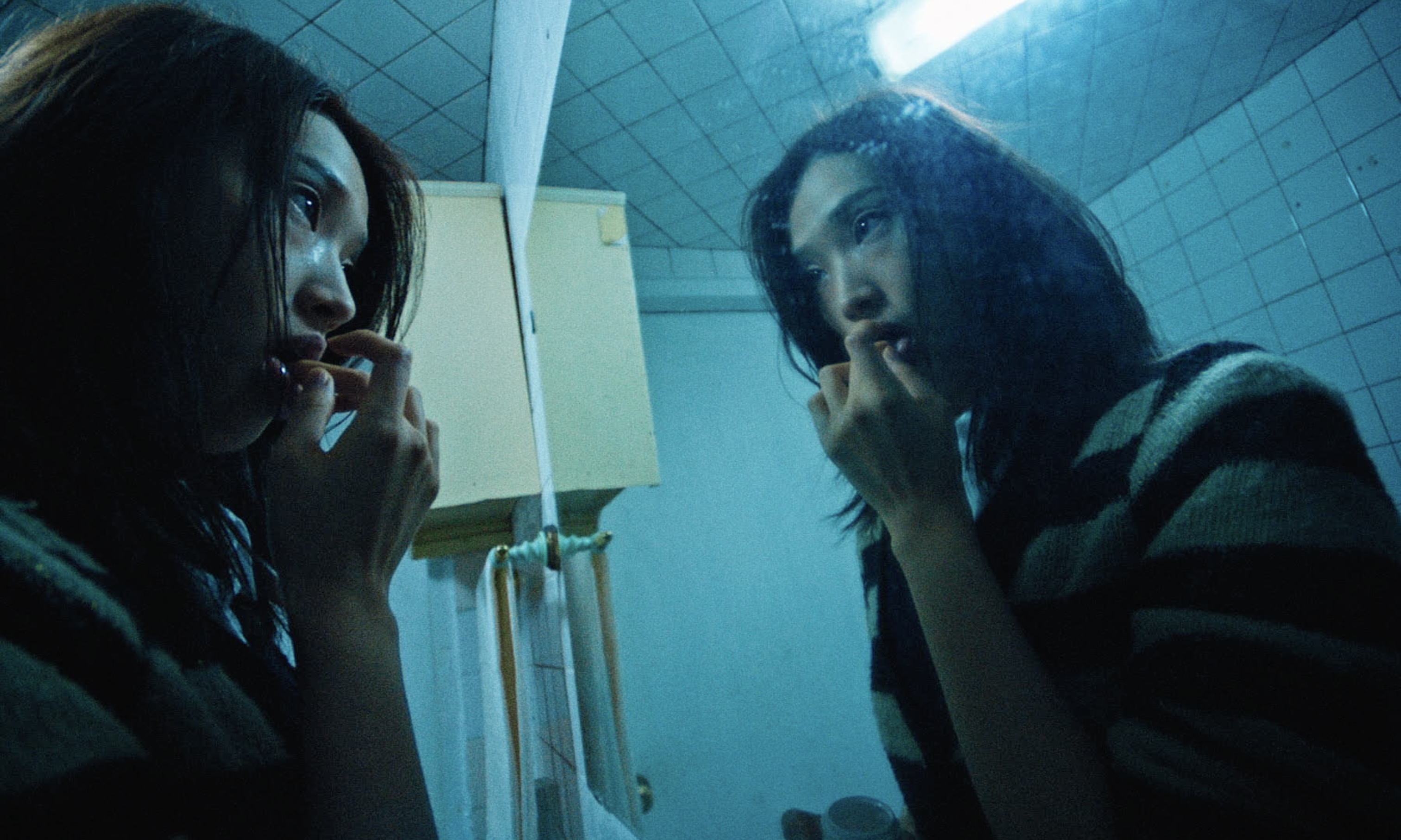
Three high school friends have their dynamics change when a charismatic, handsome, and rich new transfer student arrives at their rural school. At first glance this premise sounds painfully mundane, another Korean independent film that tells a coming-of-age story about students suffocating under academic pressure, clawing their way toward elite universities while their personal identities get stamped out.
But Funky Freaky Freaks isn’t really interested in that version of adolescence. At least not on its surface.
Director Han Chang-rok has said that he wanted to examine Korean society through this story, and in doing so he reveals as much about his own anxieties as he does about the country itself. In a culture where image, presentation, and social standing carry enormous weight Han chooses instead to focus on a loose group of outsiders. These are not model students grinding toward SKY universities. They are already broken, aimless, and mostly discarded even from the very first scene. They’re not really rebelling with a manifesto; they’re rebelling because it's all they have.
The film is broken down into three sections “Impulse,” “Collision,” and “Shock”, making its intentions pretty clear from the outset. And yet this is also an early indicator of the kind of problems that plague this film. There are clear echoes of Darren Aronofsky’s Requiem for a Dream in the structure, four young people starting from a shared emotional space before spiraling into their individual compulsions and vices. But where Aronofsky weaponized unpredictability and formal experimentation to genuinely destabilize the audience, Funky Freaky Freaks telegraphs its trajectory early on. Once the transfer student’s dark past begins to surface, the emotional endpoint becomes visible from miles away.
Stylistically, Han leans hard into a kind of pastiche of late-90s and early-2000s music videos. There’s a kind of MTV-filtered nostalgia running through the film and applied to modern Korean youth culture. At times, it works but oftentimes it feels like it is done just to be done, without any real direction or purpose. There are several occasions where the narrative breaks and one of the characters has a manic breakdown on screen fueled by a pulsing soundtrack and framed in spastic shapes and pulsing colors. But style without substance or purpose can feel empty, and all too often the aesthetic choices and narrative breaks don’t necessarily point to anything deeper.
One of the film’s strongest artistic choices is its original score by Seoul-based grunge-techno artist Livigesh. The soundtrack pulses, distorts, and scrapes against the images rather than smoothing them out. It gives the film a more authentic raw, grimy texture. Instead of feeling like a decorative afterthought. It drives the tempo and amplifies the instability of the film and its characters. It’s arguably the element that best captures the director’s dystopian, end-of-the-century mood.
The film also deserves credit for its willingness to brush up against taboos still sensitive within Korean society. Teenage sexuality is presented bluntly. Violence escalates quickly and disturbingly. One character’s queer identity is treated as matter-of-fact rather than sensationalized. There’s also an undercurrent of commentary about online radicalization and social identities.
Yet for all its aggressive style and thematic ambition, the film ultimately feels less radical than it wants to be. Like a stock standard film painted in a punk rock aesthetic.
The film shoots its climax as if we’re heading somewhere shocking and subversive. But the destination is largely inevitable.
And that may be the most telling aspect of the whole project.
For a film about youth colliding with society, it ultimately parks its characters exactly where society expects them to end up, broken, punished, or consumed by their own impulses. Han shows empathy toward these misfits, but he doesn’t quite liberate them. The rebellion is aesthetic; the ending is conventional.
That doesn’t make the film a failure. In fact, there’s something admirable about its rough edges. It feels like a debut determined to experiment and made by a director trying to scream something about the difficulties of adolescence in a hyper-digitized, hyper-judgmental Korea. But urgency without restraint can become noise, and at times the camera tricks and aggressive stylization drown out the deeper social commentary.
Still, in an industry often defined by polish and formula, there’s value in a film this abrasive. Even when it prioritizes style over substance, it pushes against the clean, controlled surfaces of mainstream Korean cinema.
